
Does my studio have the right to train an AI on the rest of the team's work?
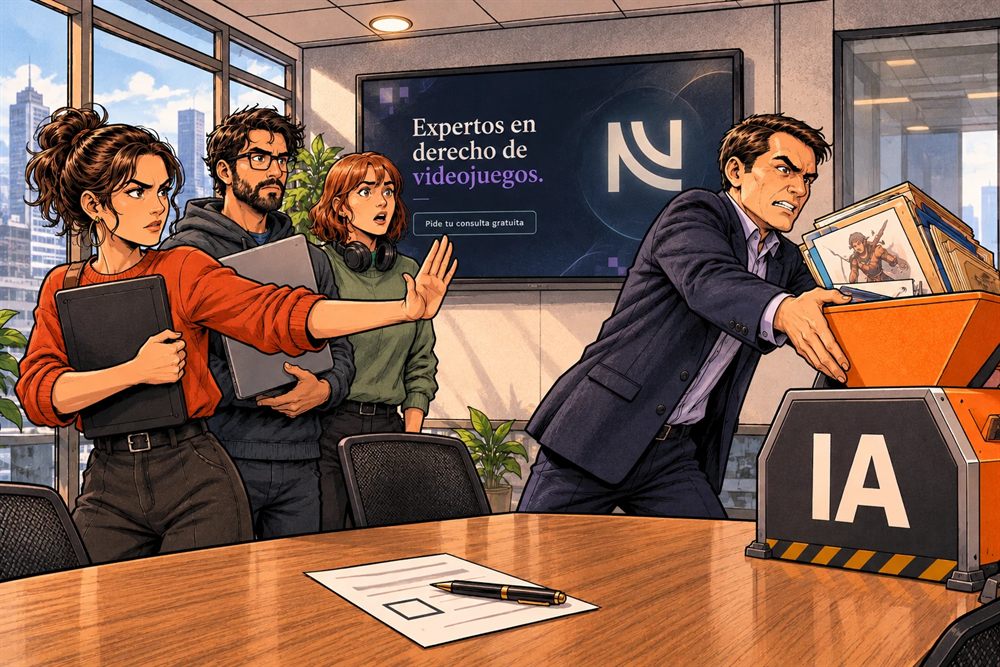
The studio signs up for a generative AI tool and someone suggests feeding it all the art, music and code the team has produced in five years, so that it can generate more in the same style. Six European unions in the sector, Spain's CSVI among them, have published a manifesto, reported on 17 November 2026, asking that this should not happen without the consent of whoever created the work. The legal answer to the question in the title depends on the asset. For code, the law gives the rights to the studio. For art, music and text, the studio only has what the contract says or, if the contract is silent, what is necessary for its usual business at the time it received the work. Training an AI may fall outside that, which is why the debate on generative AI in game development starts with knowing who owns what.
Generative AI in game development, what the unions' manifesto says
The document is titled On Generative AI Usage in the Games Industry and is led by the UK's IWGB Game Workers Union. According to GamesIndustry.biz, which reported it on 17 November 2026, it was written with Ireland's GWUI, Spain's CSVI, France's STJV, Germany's GDRT and Italy's FIOM-CGIL Milan Work Council.
Its starting point is blunt, "Generative AI is currently harming the games industry, its workers and the games they produce". And it refuses to treat it as a given, "it is not inevitable".
The text groups its reasons into five concerns, which are worse working conditions, damaged relations between workers and employers, the appropriation of workers' output, the discrimination carried by training data and hidden costs. The third is the one that touches intellectual property. The manifesto argues that employers often assume they can add employees' contributions to internal datasets without consent and without extra pay.
Its requests to studios follow from that.
- Participation. Staff should take part in AI policy. The manifesto puts it by saying workers should be the ones who decide "when, where, and how to use it".
- No obligation. Nobody should be required to use generative AI and, where it is used, it should be labelled precisely.
- No training without permission. Employees' work should not be used as training data and, if it is, only with explicit consent, fair pay and the right to withdraw it.
It asks regulators to forbid adding a person's work to a generative AI dataset without their permission. None of this is law in Spain today. What does exist is an ownership regime that already answers a good part of the question.
Who owns what an employee creates at a studio
Spain's Intellectual Property Act has two different rules, and the difference between them is what confuses studios most.
Code. Article 97.4 provides that, where an employee creates a computer program in the course of the duties entrusted to them or following the employer's instructions, the exploitation rights belong exclusively to the employer, unless otherwise agreed. This covers both source code and object code. The studio needs no clause to own its employees' code.
Everything else. Models, illustrations, animations, the soundtrack, the script and the dialogue are governed by Article 51. The transfer to the employer depends on what the contract says, and the contract must be in writing. Without a written agreement, the rights are presumed to have been assigned exclusively and to the extent necessary for the employer's usual business at the time the work was delivered. The third paragraph closes the door on uses that go further, because the employer may in no case use the work for a different sense or purpose.
In other words, a studio with nothing signed with its artist can publish the game with their illustrations, because that is its usual business. What it does not have secured is any use other than that.
Two more limits complete the picture. The moral rights of Article 14, including attribution and respect for the integrity of the work, cannot be waived and stay with the author even when they are an employee. And all of this applies to employees only. With external contributors there is no such presumption, and the assignment is limited to what was agreed and to what is indispensable for the purpose of the contract, as we explain in who owns the code a contributor without a contract adds to your game and in whether a freelance composer can stop their soundtrack from being commercialised.
Can the studio train an AI on those works?
Again, the two have to be separated.
With its employees' code, yes. It owns the exploitation rights and may reproduce it for whatever it needs, including fine-tuning an internal tool.
With art, music and text, it depends on three things.
- What the contract says. A clause assigning the rights for any form of exploitation, including use to train or fine-tune AI systems, solves the problem going forward.
- The usual business at the time of delivery. Without a clause, the question is whether training a model was part of the studio's usual business when the artist handed in the work. For an illustration from 2021 that is hard to argue. The Act adds in Article 43.5, for assignments in general, that a transfer does not extend to forms of use or means of dissemination that did not exist or were unknown at the time of the assignment.
- The text and data mining exception. Article 67 of Royal Decree-law 24/2021 allows, without the rightholder's authorisation, reproductions of lawfully accessible works made for automated analysis, unless the rightholder has expressly reserved that use. The studio has lawful access to what its employees deliver, and many of those who train models rely on this exception.
At NN Agency we think the exception does not close the debate, for two reasons. The first is that it covers the copy made in order to analyse, not what the model produces afterwards. If the system generates images that recognisably reproduce a person's work, that exploitation needs a legal basis again. The second is that it admits a reservation, and nothing prevents an author who retains rights from making one. It is an open question, with no Spanish case law that we are aware of, which is why an express clause is worth more than any interpretation.
The consent the manifesto asks for is therefore not a general legal requirement. But a studio that trains a model on its team's art without having agreed it is relying on a presumption designed for something else.
The other side, what the AI generates has no copyright
The discussion about staff's work hides a problem that goes straight to the studio's value. Article 5 of the Act treats as author the natural person who creates a work. What an AI generates without a person's creative contribution has no author and is not protected, as we explain in whether you are the author of content you generate with AI.
In a studio that uses generative AI in production, the game ends up as a mix of three things, namely what people created, what the tool generated, and what was generated and then reworked by someone. Only over the first and, depending on the degree of intervention, the third are there rights to enforce against a copier.
That is why the studio needs to know what each asset is. Without that inventory it cannot register safely, it cannot answer a publisher or an investor asking who owns the game, and it cannot react to a clone, which is exactly what we cover in whether someone can copy your game with AI from the demo if you never registered it. The tool matters too. Each service's terms say who owns the output and what the provider may do with what is uploaded, as we saw with Google Playground.
There is a third risk, secrecy. Unpublished code and design documents are trade secrets as long as the studio takes reasonable steps to keep them so, which is what Spain's Trade Secrets Act requires. Uploading them to an external tool whose terms let the provider reuse them is hard to reconcile with that requirement. We deal with it in whether a studio can protect the way it works internally.
What a studio owes its staff when it uses AI
The manifesto wants workers to decide. Spanish law does not go that far. Article 20 of the Workers' Statute leaves the direction of work to the employer, and choosing the tools is part of it. There are, however, two obligations that already exist and a third with a date.
- Information to workers' representatives. Article 64.4 of the Statute gives the works council the right to be informed of the parameters, rules and instructions behind algorithms or AI systems that affect decisions with an impact on working conditions and on access to and retention of employment. It covers AI that evaluates, allocates tasks or measures performance. It does not, on its own, cover AI that generates textures.
- Training. Article 4 of the EU AI Act, as amended in July 2026, requires those who use AI systems to take measures to support their staff's AI literacy, without requiring them to guarantee a specific level for any individual. It goes in the direction of one of the manifesto's requests.
- High-risk systems, from December 2027. When the studio uses at work a system the AI Act classifies as high-risk, which includes those used for recruitment and for evaluating staff, Article 26.7 will require it to inform workers' representatives and the affected workers beforehand. The 2026 amendment postponed that obligation to 2 December 2027.
The rest is a matter for negotiation. A collective agreement or a company agreement can include what the manifesto asks for, and a studio may prefer to agree it before it turns into a dispute.
A studio's AI policy, point by point
At NN Agency we recommend that any studio using generative AI have at least the following in writing.
- Which tools are used and what for. With their terms read, especially what the provider does with what is uploaded and who owns what comes back.
- What may go into them. The studio's own code, yes, as long as the tool guarantees confidentiality. Employees' art, music and text, only if the contract covers it. External contributors' work, only with an express assignment. Nothing from third parties without a licence.
- Contracts. An assignment clause that mentions use with AI systems in new contracts, and an annex for work already delivered if the studio wants to train on it.
- The inventory. Which assets were created by a person, which were generated by a tool and with what human intervention. It is the basis for registering and for proving.
- Staff. Training, information to workers' representatives where required and a clear rule on whether use is mandatory.
- Labelling. What players and stores are told about the use of AI in the game.
It is the document that lets a studio answer, the day a publisher, an investor or its own staff asks, who owns its game.
Frequently asked questions
▸Who owns copyright in a work created by an employee at a game studio in Spain?NPC
▸Can my employer use my work to train an AI?NPC
▸Can I be forced to use generative AI at work?NPC
▸Is what an AI generates at the studio protected by copyright?NPC
▸What does the game workers' AI manifesto ask for?NPC
▸Does the studio have to inform workers' representatives?NPC
▸What about freelancers' work?NPC
▸Does a studio lose trade secret protection for its code by uploading it to an AI tool?NPC
Sources
- IWGB Game Workers, On Generative AI Usage in the Games Industry
- GamesIndustry.biz, IWGB Game Workers Union leads manifesto on generative AI use in the industry, 17 November 2026
- Spanish Intellectual Property Act, Articles 5, 14, 43, 51 and 97, consolidated text, in Spanish
- Royal Decree-law 24/2021, Article 67, text and data mining, consolidated text, in Spanish
- Spanish Workers' Statute, Articles 20 and 64, consolidated text, in Spanish
- Regulation (EU) 2024/1689, the AI Act, Articles 4 and 26, EUR-Lex
- Regulation (EU) 2026/1744 amending the AI Act, Official Journal of 24 July 2026
- Spanish Trade Secrets Act 1/2019, Article 1, in Spanish
At NN Agency, as video game lawyers, we help studios know who owns each part of their game and register it, draft contracts with employees and contributors, including for the use of AI and prepare their internal AI policy and the game's legal texts. If your team already works with generative AI and nothing in writing says what may go into it, let's talk. The first consultation is free.
Facing something similar at your studio? The first consultation is free.
Free consultation